

















Top activities
Top landmarks
Trip ideas
Nearby places
Port schedule
You booked this experience
Make your trip unforgettable

Roman Forum Myths and Legends Private Guided Tour

7 Reviews 4.86 out of 5 stars Based on 7 traveler reviews collected by Cool Shore Excursions and TripAdvisor | Recommended by 100% of reviewers | Rome, Italy
Don't miss out!
On average, this is booked 28 (0) days in advance.

2 hours (approx.)
Mobile ticket
Offered in: English
Instant confirmation

Overview

Embark on a journey through the legends of ancient Rome! Explore the myths and stories that shaped the beliefs and values of one of the world’s most powerful empires.

From the founding of Rome by Romulus and Remus, to the tales of the god-like Julius Caesar, and hear tales of brave soldiers, and cunning politicians as you walk through the heart of the once-great empire.

Immerse yourself in the rich history and culture of Rome as you learn about the founding of the city and the legendary figures who shaped its destiny. Join us for an unforgettable journey through the myths and legends of ancient Rome.

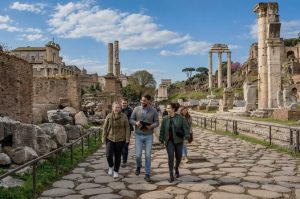
Explore the historic centre of the powerful Roman Empire and learn about its gods, myths and legends.

What's Included

  • Official guide
  • Entrance ticket to the Roman Forum, Palatine Hill, Imperial Forums
  • Roman Forum guided tour
  • Hotel pick up and drop off
  • Transportation to/from attractions
  • Food and drinks
See 3 moreSee 5 more

Meeting Location

Meeting point

Largo della Salara Vecchia
Roma RM, Italy

Show on Google Maps

Detailed check-in instructions, including the exact address, are provided with your booking confirmation.

End point

This activity ends back at the meeting point.

What To Expect

Book Online

Our secure website provides real-time availability, instant confirmation, and free, no-hassle cancellations up to 24 hours before your tour begins.
Read more

Safe & secure Easy breezy Hassle‑free

Lapis Niger

The Lapis Niger (Latin for "Black Stone") is an ancient shrine located in the Roman Forum that dates back to the 6th century BCE. According to legend, the shrine was built over the spot where the body of the legendary Roman king Romulus was buried after he was murdered by his own people. Interestingly, despite its ancient age and significance, the Lapis Niger was actually discovered by accident in the 19th century. During excavations in the Roman Forum in 1899, archaeologists stumbled upon the Lapis Niger while digging beneath a medieval pavement. The discovery caused a sensation among scholars and archaeologists at the time, nobody expected to find the tomb of a king.
Read more

5 minutes Admission Ticket Included

Basilica Emilia

The Basilica Emilia is that it was one of the most important public buildings in ancient Rome, serving as a meeting place for senators and a center for legal and commercial activities. The original basilica was built in the 2nd century BCE, but it was destroyed by fire and rebuilt several times over the centuries. The ruins of the basilica can still be seen today in the Roman Forum, and they provide a fascinating glimpse into the architecture and engineering of ancient Rome.
Read more

10 minutes Admission Ticket Included

Tempio di Antonino e Faustina (pass by)

The Temple of Antoninus Pius and Faustina is an ancient Roman temple that was dedicated to the deified emperor Antoninus Pius and his wife, Faustina the Elder. According to legend, the temple was built to commemorate the couple's love for each other. Antoninus Pius was known for his peaceful reign and his dedication to the arts and sciences, while Faustina the Elder was famous for her beauty and her philanthropic work. The temple was one of the largest and most ornate in Rome, featuring intricate carvings, statues, and other decorations.After the fall of the Roman Empire, the Temple of Antoninus Pius and Faustina fell into disrepair and was used for various purposes over the centuries, including as a church. Today, the temple's ruins are still visible in the Roman Forum, and they serve as a reminder of the grandeur and majesty of ancient Rome.
Read more

Regia (pass by)

The Regia was an ancient Roman building located in the Roman Forum that served as the official residence of the kings of Rome and later the pontifex maximus, the high priest of Rome. According to legend, the Regia was built after the advice of the goddess Egeria with whom the Roman king Numa Pompilius used to hold meetings. Egeria was said to have advised him on matters of state and religion. Another interesting fact about the Regia is that it was considered one of the most sacred and important buildings in Rome. The building was associated with many important religious and political ceremonies.Today, only a few ruins of the Regia remain in the Roman Forum, but they serve as a reminder of the building's rich history and importance in ancient Rome.
Read more

Tempio di Vesta (pass by)

The Temple of Vesta was a significant religious site in ancient Rome, located near the Regia in the Roman Forum. It was where the Vestal Virgins, a group of six priestesses chosen at a young age and required to remain celibate for thirty years, tended to the sacred flame that represented the eternal life of Rome. The Vestal Virgins were highly respected in ancient Rome, and their status was almost equal to that of the Roman senators. They were responsible for keeping the flame burning at all times, and their purity was considered essential for the well-being of the Roman state. Any breach of their vow of chastity was considered a grave offense, and a Vestal Virgin found guilty of breaking her vow was buried alive as punishment.
Read more

Casa delle Vestali

The House was a large complex that consisted of several buildings, including living quarters for the Vestal Virgins, a temple dedicated to Vesta, and various administrative and ritual spaces. The Vestal Virgins were chosen from among young girls between the ages of six and ten years old who had been selected for their physical and mental purity. Once chosen, they served a term of thirty years, during which time they were expected to remain celibate and perform their religious duties. The Vestal Virgins were held in high esteem by the Roman people and enjoyed many privileges, including the right to own property and the power to grant clemency to condemned prisoners. They were also exempt from certain laws and were allowed to ride in a carriage, which was a privilege reserved for only the highest-ranking officials.
Read more

15 minutes Admission Ticket Included

Fonte di Giuturna

In Roman mythology, Juturna was the goddess of fountains, wells, and springs. According to legend, Juturna was a nymph who was desired by the god Iuppiter (Zeus). When Iuppiter tried to force himself upon her, she escaped and was transformed into a spring, which became known as the Juturna Spring. The spring was believed to have healing powers, and people would come from all over Rome to bathe in its waters.
Read more

5 minutes Admission Ticket Included

Il Tempio dei Dioscuri (pass by)

According to legend, the twin gods Castor and Pollux, also known as the Dioscuri, played a significant role in the Battle of Lake Regillus, a legendary battle fought between Rome and the Latin League in the late 6th century BCE. After the battle, the Dioscuri were said to have appeared on horseback at the Roman Forum and announced the Roman victory. As a result, a temple was dedicated to them in the Forum to honor their role in the battle and their continued protection of the Roman state. The temple of Dioscuri, also known as the Temple of Castor and Pollux, partially still stands in the Forum today.
Read more

Lacus Curtius

According to legend, the Lacus Curtius was named after a young Roman soldier named Curtius who sacrificed himself to save Rome from destruction. The story goes that a deep chasm had suddenly opened up in the Roman Forum, and the Sibylline Books prophesied that Rome would only be saved if its most valuable possession was thrown into the abyss. Curtius, dressed in full armor and riding his horse, bravely rode into the chasm and disappeared, causing it to close up and Rome to be saved. To commemorate this act of heroism, a small lake was created on the spot where the chasm had been, known as the Lacus Curtius.The story of Marcus Curtius and the Lacus Curtius was later used as a symbol of self-sacrifice and devotion to Rome.
Read more

10 minutes Admission Ticket Included

Tempio di Saturno (pass by)

According to Roman mythology, the Temple of Saturn was built at the site where Saturn, the god of agriculture, had originally established his reign. Saturn was believed to have brought civilization to Italy and taught the people agriculture, making him an important deity to the early Romans. The temple housed the state treasury, and during the Saturnalia festival, which celebrated the god's agricultural influence and lasted from December 17 to December 23, the treasury was opened and gifts were exchanged. Dating back to the early 5th century BCE is the first large temple built in roman forum.
Read more

Umbilicus Urbis

The Umbilicus Urbis in Rome is a conical brick structure with a door that leads to an underground cavity. According to Plutarch's account of Rome's foundation, Romulus dug a circular pit in the Comitium and threw in offerings and a handful of soil from each follower's homeland. This pit was called the "Mundus," and was considered the center of the circular furrow that marked Rome's sacred boundary. The Mundus was opened only three days a year to communicate between the worlds of the living and the dead. It was considered impious to engage in any public activities during these days.
Read more

10 minutes Admission Ticket Included

Arco di Settimio Severo

The Arch of Septimius Severus is one of the most well-preserved triumphal arches in Rome, and it is famous for its impressive reliefs depicting scenes from the emperor's military campaigns. The arch was also used as a model for the Arc de Triomphe in Paris, which was built over a thousand years later. Additionally, the Arch of Septimius Severus has stood as a symbol of victory and military prowess for centuries, making it a popular destination for tourists and history enthusiasts alike.One fun fact about the Arch of Septimius Severus is that it has survived many earthquakes and floods throughout the centuries, and it even served as a medieval fortress in the 14th century. It is a testament to the durability and resilience of Roman engineering and construction.
Read more

15 minutes Admission Ticket Included

Milliarium Aureum (pass by)

The Miliarium Aureum was a monument in Rome that served as the central hub for measuring distances to other cities throughout the empire. It was erected by Emperor Caesar Augustus in the early 1st century AD and is considered one of the oldest surviving milestones in the world.As for the expression "all roads lead to Rome," it was coined during the Roman Empire when the city of Rome was the hub of a vast network of roads that connected it to all parts of the empire. The Romans built more than 50,000 miles of paved roads throughout their empire, and all of these roads radiated out from Rome. The Miliarium Aureum served as the central point from which all these roads were measured.While the expression "all roads lead to Rome" is often used figuratively to mean that there are many different ways to achieve a goal, it was originally a literal statement about the Roman road network and the importance of the city of Rome as the center of the empire.
Read more

Basilica Julia (pass by)

The Basilica Julia played an important role in the Roman legal system as it was one of the main locations for conducting trials and legal proceedings in ancient Rome.The building was used as a courthouse, where judges and lawyers conducted trials and heard cases. It also housed government offices and served as a meeting place for the Roman Senate. The basilica was equipped with a raised platform or tribunal where the judges sat, as well as spaces for the parties and witnesses involved in the trial.The Roman legal system was based on the principles of law and justice, and it influenced modern legal systems in Europe and beyond. The law was considered a fundamental pillar of Roman society, and its influence can still be seen in the architecture and organization of modern courthouses and legal institutions.The Basilica Julia, as a symbol of Roman justice, reflects the importance of law and order in Roman culture and history.
Read more

Curia Julia (pass by)

The Curia Julia was the meeting place of the Roman Senate, the political institution that advised the Roman magistrates and had a significant role in the governance of the Republic and later the Empire. The Curia Julia was built by Julius Caesar in 44 BC after he became dictator, and it replaced an older Senate house.The Senate, which consisted of around 300 members, held regular meetings in the Curia to discuss and debate matters of state. The meetings were presided over by the consuls, or in their absence, by other magistrates. The Senate had the power to pass laws, approve or reject treaties, and make important decisions related to foreign and domestic policy. It was a powerful institution that played a crucial role in the Roman political system.Today, only the outer walls of the Curia Julia remain standing, but it remains an important symbol of the power and influence of the Roman Senate in the ancient world.
Read more

Temple of Divus Julius

The Temple of the Deified Julius, also known as the Temple of Divus Julius or Temple of Caesar, was built in Rome by Augustus after the death of Julius Caesar and was the first temple in Rome dedicated to an individual who was not a god or goddess.The plebs, or the common people of Rome, were reportedly devastated by Julius Caesar's death and mourned him deeply. Many of them saw him as a champion of the people and a defender of their rights against the aristocratic Senate. His death sparked widespread unrest in the city, and the funeral procession for Caesar was said to have been one of the largest in Roman history, with an estimated crowd of over 100,000 people.
Read more

20 minutes Admission Ticket Included

Show 15 more stops

Additional Info

  • Confirmation is instant and will be received at time of booking
  • Wheelchair accessible
  • Transportation options are wheelchair accessible
  • Public transportation options are available nearby
  • Suitable for all physical fitness levels
  • Infants and small children can ride in a pram or stroller

Frequently Asked Questions (7)

Q: What is the cancellation policy for the Roman Forum Myths and Legends Private Guided Tour?

A: You can cancel up to 24 hours in advance of the tour for a full refund. For a full refund, you must cancel at least 24 hours before the tour start time.If you cancel less than 24 hours before the tour start time, the amount you paid will not be refunded.Any changes made less than 24 hours before the tour start time will not be accepted.Cut-off times are based on the tour local time (CET). Read more Apr 2025

Cancellation Policy

You can cancel up to 24 hours in advance of the tour for a full refund.

Still have questions?

We're here to help.
Activity code: C-401403P4

Traveler Photos

Reviews

4.86
7 reviews

Average 4.86 out of 5 stars based on 7 traveler reviews collected by Cool Shore Excursions and partner sites such as Cool Destinations and TripAdvisor

5 stars
6
4 stars
1
3 stars
0
2 stars
0
1 star
0
Don't miss out!
On average, this is booked 28 (0) days in advance.

Similar Tours & Activities

Roman Twilight Tales: legends, curiosities and Spritz!

This walking tour through the heart of Rome, where ancient history, legends, and lively local culture intertwine at every corner. We begin at the iconic …More

This walking tour through the heart of Rome, where ancient history, legends, and lively local culture intertwine at every corner. We begin at the iconic...

2 hours Free Cancellation
5.0 (1)
from
$69

Trevi Fountain Underground Aqueduct and Spanish Steps Tour

This is a small and intimate group walking tour of no more than 12 people. We'll start by the Spanish steps, where you'll learn everything …More

Likely to Sell Out
Likely to Sell Out

This is a small and intimate group walking tour of no more than 12 people. We'll start by the Spanish steps, where you'll learn everything...

2 hours Free Cancellation
4.9 (242)
from
$59

Catacombs, Colosseum, Roman Forum & Palatine Hill Private

No visit to Rome is complete without a visit to the Roman Colosseum. As one of the most recognized landmarks in the world, the Colosseum …More

No visit to Rome is complete without a visit to the Roman Colosseum. As one of the most recognized landmarks in the world, the Colosseum...

5 to 6 hours Hotel pickup offered
4.8 (5)
from
$568

Castel Saint Angelo Audio Guided Tour with Tickets

Late the day before the reservation, the final ticket will be sent by email and/or also by WhatsApp message. Check your spam if you do …More

Late the day before the reservation, the final ticket will be sent by email and/or also by WhatsApp message. Check your spam if you do...

1 to 2 hours
4.0 (1)
from
$46

Travelers Who Bought This Tour Also Bought

Skip-the-Line Group Tour of the Vatican, Sistine Chapel & St. Peter's Basilica

A holiday in Rome without visiting the Vatican is like a day at the beach without swimming in the sea. See the best of the …More

Likely to Sell Out
Likely to Sell Out

A holiday in Rome without visiting the Vatican is like a day at the beach without swimming in the sea. See the best of the...

3 hours Free Cancellation
4.8 (14,679)
from
$21

Rome Pasta and Tiramisu Class: Ravioli, Fettuccine & Fine Wine 5*

Begin with learning how make tiramisù, following traditional recipes using all ingredients- mascarpone, eggs, coffee sugar and cocoa powder and tools needed. Following this, learn …More

Likely to Sell Out
Likely to Sell Out

Begin with learning how make tiramisù, following traditional recipes using all ingredients- mascarpone, eggs, coffee sugar and cocoa powder and tools needed. Following this, learn...

3 hours Free Cancellation
5.0 (4,142)
from
$33

Learn to Make Pasta & Tiramisu with Wine and Limoncello Included

Enjoy Fettuccine and Tiramisu cooking class in the heart of Rome! During this class you will learn how to make Fettuccine pasta from scratch and …More

Likely to Sell Out
Likely to Sell Out

Enjoy Fettuccine and Tiramisu cooking class in the heart of Rome! During this class you will learn how to make Fettuccine pasta from scratch and...

2 hours Free Cancellation
4.9 (3,170)
from
$56

Pizza Cooking Class in Rome - Near Piazza Navona

Who can say no to Pizza? Especially for Italian pizza? We definitely can't! If you're like us, joining a pizza class in Rome should be …More

Likely to Sell Out
Likely to Sell Out

Who can say no to Pizza? Especially for Italian pizza? We definitely can't! If you're like us, joining a pizza class in Rome should be...

2 hours Free Cancellation
4.9 (1,479)
from
$44

What's Included

Activity name

  • Official guide
  • Entrance ticket to the Roman Forum, Palatine Hill, Imperial Forums
  • Roman Forum guided tour
  • Headset to hear the guide clearly (over 6 people)
  • Hotel pick up and drop off
  • Transportation to/from attractions
  • Food and drinks
  • Gratuities
  • Colosseum access

Additional Info

Activity name

  • Confirmation is instant and will be received at time of booking
  • Wheelchair accessible
  • Transportation options are wheelchair accessible
  • All areas and surfaces are wheelchair accessible
  • Service animals allowed
  • Public transportation options are available nearby
  • Suitable for all physical fitness levels
  • Infants and small children can ride in a pram or stroller
  • The full names (as written in the ID or Passport) of all the participants in the booking are needed at the time of the booking, incomplete information on the booking cannot guarantee the entrance to the Roman Forum. ID or passport are mandatory. Guests who show up without ID or passport cannot be guaranteed entrance.


Report Product Issue

Activity name